917-628-3200

Approach to Lighting



My Approach to Lighting

When people ask me about “good” lighting and “bad” lighting, my answer is always the same — there’s no universal rule. Lighting is good if it tells the story you want to tell. It’s not about perfection; it’s about purpose. Lighting is like the backing vocals in a song — you may not notice it consciously, but it sets the tone, mood, and emotion of the entire piece.

Lighting can be soft and gentle, or harsh and frightening. It can create intimacy, drama, romance, or tension. It can make a photograph feel timeless, mysterious, or brutally honest. And yes — it can make or break an image entirely.

We have the sun, of course, the ultimate light source. Most fashion and location photographers still rely on it, whether as their main light or as a rim light. The sun casts a single shadow — sharp and long in late afternoon, softer at midday. Even when I work with multiple artificial lights — six, ten, even twenty-four — I aim to make them feel like they could be coming from that single natural source.

When lighting, I always ask myself: What time of day is this scene happening? Where is the light coming from? What is it touching?

For product photography, the goal is often to put the client’s item in its “best light.” Sometimes that’s bright, open “Amazon-style” lighting — midday, minimal shadow, nothing hidden. But if I’m telling a story, I might lean into chiaroscuro — that dramatic balance of light and dark made famous in 1930s–40s film noir. Black-and-white masters used gradients from pure white to deep black to create mystery and mood.

Lighting also controls how the viewer looks at an image. If everything is evenly lit, the eye just sits in the middle, taking it all in at once. But add shadow to one area and highlight to another, and suddenly the eye moves, exploring the frame. The highlight says, Look here. The shadow whispers, Look deeper.

For example, if I were photographing a high-end whiskey, I wouldn’t “blast it” with flat light. I’d use shadow to deepen its amber tones, add a highlight to the label, and let the darkness around it make the viewer linger. That extra few seconds of attention — that’s where the product becomes memorable.

Different brands require different approaches. Old Navy might want bright, cheerful, evenly lit product shots that say “fun and affordable.” Nike, on the other hand, thrives on high-contrast, dramatic lighting that conveys performance, intensity, and aspiration.

For me, lighting isn’t just technical — it’s emotional. It’s about shaping the way someone feels when they see the image. It’s about creating that same magic you feel when the setting sun cuts through the trees and paints the world in gold and shadow. That’s the power of light — and that’s why I treat it as my most important storytelling tool.
What Photoshop Teaches Us

What Photoshop Taught Us About Creative Tools—and What That Means for AI

A Flashback to the Photoshop Revolution

When Photoshop first entered the creative world, it caused a massive shakeup. Ad agencies believed they had discovered a silver bullet. No more need for seasoned photographers, expert retouchers, or experienced art directors.

They could now hire young talent straight out of college—people who knew the software but lacked real-world experience behind a camera or in a studio. In-house studios sprang up overnight. The goal? Cut costs and move fast.

It worked—for a while.

The Reality Check Came Fast

Within a year or two, clients and agencies realized things weren’t adding up. Retouching bills skyrocketed. Production time dragged on. Budgets ballooned to nearly three times the cost of traditional workflows.

Why? Because technical problems that seasoned photographers could solve in-camera—like controlling highlights or managing shadows—were now pushed to post-production. The go-to excuse? “We’ll fix it in Photoshop.”

What should’ve been a five-minute lighting adjustment turned into thousands in retouching.

Experience Made a Comeback—With a Raise

Eventually, the accountants noticed. Photoshop wasn’t saving money—it was draining it. Clients were frustrated. Quality was inconsistent. And deadlines were missed.

The solution was clear: bring back the pros.

Agencies rehired experienced art directors and senior creatives—this time, at higher salaries. The same photographers who had been pushed out were now welcomed back. And many of them had already mastered Photoshop themselves, combining decades of hands-on knowledge with cutting-edge tools.

What This Means for AI Today

History repeats itself. AI is the new Photoshop. It’s powerful. It’s fast. It’s changing the game.

But just like before, those who truly understand their craft—lighting, composition, emotion, storytelling—will remain essential.

AI won’t replace photographers. It will challenge them to evolve.

Make AI Work With You, Not Instead of You

AI can enhance your work, expand your creativity, and speed up workflows. You can upload your own images, generate variations, and build stronger concepts.

But the core of great photography—the human vision, instinct, and ability to solve problems on set—can’t be duplicated.

You must ask yourself: How can I use AI to enhance my portfolio and meet my client’s needs, without losing my creative voice?

BRAIN POWER: The Ultimate Creative Tool

Capturing an image is more than clicking a button. It’s problem-solving. It’s visual thinking. It’s collaboration. It’s the art of making something out of nothing.

It’s thrilling.

The real work happens before the shutter clicks. You blend direction, lighting, mood, and your own artistic vision. That effort will always feel more fulfilling than typing prompts and waiting for an algorithm to guess your intent.

Let’s be honest—AI pulls from billions of images. The result often isn’t your creation. It’s a remix of someone else’s.

Conclusion: Tools Come and Go, Vision Stays

The lesson from the Photoshop era is crystal clear: tools don’t make the artist. Artists make the tools matter.

AI is just the latest. You can fight it, fear it—or use it. But it won’t replace the heart and brain that go into every great photograph.

Adapt, evolve, and stay creative. Because the best work still starts with you.

The 6 – 10 Sec Rule

Will AI Replace Photographers? Why the Answer Is “Not a Chance”

The 10-Second Rule in Advertising

There’s a saying in advertising that still holds true: if an ad can make someone stop and look for 7 to 10 seconds, the creative team has done their job. That moment of attention is gold. These days, thanks to visual overload, you’re lucky to get 3 to 5 seconds. But if you do, the ad is still a win.

Now, the question is more pressing than ever:

Will photographers become obsolete in the age of AI?

The Short Answer: No, Photography Isn’t Dying

The truth is simple—photography isn’t going anywhere. What is happening is a weeding out. It’s been going on since Photoshop first launched. Only the most talented and driven rise to the top and stay there. The rest fade.

Technology doesn’t replace creativity. It only challenges creatives to evolve.

AI Is Just Another Tool—Not a Threat

Whether it’s Photoshop, Midjourney, or generative AI, these tools are extensions of your creative process. They don’t replace your mind. They don’t replace your instincts.

As photographers, we start with an idea. A concept. We visualize before we even touch the camera. Whether that vision is built with light and glass or typed into an AI prompt, what matters is the final image—and if it hits the mark.

Still, AI has its limits. Many outputs feel too perfect or too fake. They often miss the soul, the imperfection, the tactile essence that makes real photography human.

The Emotional Thread in Image Making

In the 1980s, the tone of ads reflected the national mood. Bright, crisp, colorful when things were booming. Soft, hazy, moody when society was unsure. Whether intentional or not, imagery echoed culture.

AI doesn’t have that instinct. It doesn’t feel. It doesn’t live in the same emotional space that photographers do when crafting an image with intention.

That’s what makes human-made images last.

Photography Is an Act of Artistry

AI images are spun from existing work. Enter some keywords, wait, and you get a mashup of billions of other artists’ ideas. There’s little challenge, no pressure, and often no soul in that process.

Real photography demands problem-solving. Lighting. Composition. Timing. Communication. You study your client, understand their message, and deliver an image that makes people stop and feel something. That’s artistry.

We’ve Seen This Before With Photoshop

When Photoshop entered the industry, ad agencies saw a way to cut costs. Retouchers, seasoned photographers, and creative directors were replaced with fresh grads who knew the software.

Then reality hit.

Budgets soared. Retouching times tripled. Clients weren’t happy. Inexperience couldn’t match seasoned pros who knew how to light, shoot, and solve problems on set, not in post.

Eventually, agencies invited the veterans back—with raises. The industry learned that tools are only as good as the person using them.

Use AI to Elevate, Not Replace Your Craft

AI isn’t a death sentence for photography. It’s a new tool. The key is knowing how to use it to your advantage—just like Photoshop, retouching, or digital cameras.

Upload your own photos. Generate variations. Speed up comps. Solve client problems more creatively. Use AI to build, not to fake.

The difference is in your vision—not the tool.

Photography Stretches the Mind

Creating an image with your camera is a full-brain experience. It takes vision, effort, and energy. You blend art direction with technical knowledge. You solve problems in real time. You feel the rush of capturing the shot.

With AI, you’re just typing and hoping for something that hits.

There’s no adrenaline. No grit. No craft.

Sure, it’s exciting at first. But most AI-generated work isn’t yours. It’s everyone else’s, remixed and repackaged. And you feel the difference.

Conclusion: The Camera Still Has a Soul

The future belongs to the creators who adapt—those who learn how to use AI while staying true to their style. Photography is far from dead. It’s evolving.

So, will AI replace photographers?

No. But it will separate those who can create with meaning from those who can’t.

And if you’re in this game for the long run, your brain, your eye, your heart—and your camera—still matter more than ever.

Favorite Film and Why

Why Film Photography Still Matters in a Digital World

Film Experience Shapes Digital Mastery

In today’s fast-paced world of digital imaging, you might wonder: why does old-school film exposure still matter? What value can years of film photography bring to a digital shooter today? Let’s explore.

Photographers once had favorite film stocks, chosen with purpose. Each brand and type gave a specific look. Some films enhanced skin tones beautifully. Others handled shadows or highlights in ways that digital sensors still strive to replicate.

Lighting and Lens Control Was an Artform

Using powerful strobes gave photographers more than light—it gave them creative freedom. They could control flash power to suit each shot. This meant having full control over aperture settings for depth, motion, or softness.

Shooting action like a liquid pour? Easy with strobes. Want everything razor sharp, front to back? Stop down your lens to f/64 or even f/128. It was called “burying the lens,” and it delivered stunning depth.

Film Gave You Real Choices

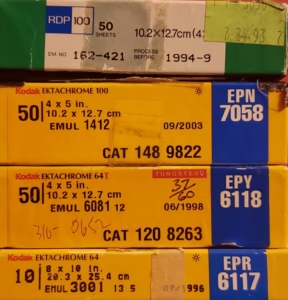
Back then, film options were abundant. Photographers could pick from a wide palette of color stocks. Today, those options are limited. According to B&H Photo, only five color sheet films are available now, compared to 29 black-and-white ones.

The richness of creative control through film was unmatched. Each choice had a purpose. Now, digital presets mimic what used to be done with a film swap.

The Ritual of Loading Film

There was something sacred about the darkroom. Loading 40 film holders—each with two sheets—was a daily ritual. Complete darkness. No shortcuts. Your hands became your eyes. Photographers learned precision through practice, not automation.

This tactile experience built discipline. You couldn’t afford mistakes. Every sheet counted. And that discipline carries into digital shooting today—where, despite endless storage, the best photographers still shoot with intention.

Film Budgets Taught Project Discipline

Before launching a studio, I worked under top-tier commercial photographers. They taught me more than lighting—they showed how to manage projects, timelines, and film budgets.

Back then, the biggest line items weren’t retouching or editing. They were film, Polaroids, and processing. Every shot cost real money. That created a mindset of efficiency. You shot what mattered. You delivered on budget.

Today, digital retouching and conversion time are the new budget challenges. But the mindset? It’s the same—make every click count.

Why This All Still Matters

Shooting film wasn’t just about capturing images. It taught awareness, preparation, and respect for the craft. You couldn’t fix it later. You had to get it right in-camera. That mindset gives digital photographers an edge today.

Digital tools are powerful, but discipline and vision still win. And that’s the biggest lesson from years of exposing film—you learn to slow down, focus, and shoot with intent.

Conclusion: Film May Fade, but the Lessons Endure

Though most film types are gone, the knowledge lives on. The hands-on, eyes-off discipline of film still shapes the best digital work today. Whether you’re editing in Lightroom or capturing a fast pour with strobes, the foundation remains the same.

Respect the process. Master your tools. And always shoot with purpose.

Assistant to the Pros

How Photography Assistants Became Pros: A Look Into the Craft Behind Commercial Shoots

The Legacy of Learning from the Masters

Commercial photography once followed a clear path of mentorship. Young assistants learned directly from seasoned pros. These professionals didn’t just teach technique—they passed down the art of visual storytelling. They understood how to take a client’s idea and transform it into a bold, confident image that spoke directly to the customer.

Great images didn’t just sell products—they built brands. Viewers connected emotionally. Before digital took over, these visuals inspired consumers to visit stores. Today, they drive online clicks, searches, and reviews.

Understanding ASA: Film Speed in the Analog Era

Back then, ASA (now known as ISO) wasn’t just a setting—it was a critical decision. Every shoot demanded thought. ASA 64 color film became the gold standard for crisp, sharp images, especially in food and beverage photography. If you needed more depth of field, you could step up to ASA 100.

Film required precision. Sheet film, especially the massive 8×10 formats, delivered stunning detail. It easily outclassed 35mm film. These large-format negatives could be enlarged to billboard size and still remain razor-sharp. While high-end digital camera backs now compete, the tactile, grain-perfect look of film was unmatched.

The Art of Shooting with Sheet Film

Shooting with large-format film came with unique advantages. Sharpness and resolution were just the beginning. These films provided clarity that modern sensors are only now starting to replicate.

One major perk? You could retouch directly on the film itself. Whether dodging highlights or cleaning shadows, these tweaks gave printers excellent material to work with. Every detail, every flaw—or lack thereof—was visible and manageable. Art directors thrived on this control.

Post-Production Was a Hands-On Craft

Before Photoshop, post-production was chemistry and light. Photographers could push film by extending development times. This brightened highlights without killing shadow detail. Pulling back—reducing development time—softened tones. Cross-processing created wild color shifts, offering creative looks far beyond the film’s original design.

Flashing the film base altered color even further. Shadows could shift to blue, green, or other hues—long before apps could fake it. Every adjustment demanded deep knowledge of materials and timing. Mistakes were expensive. But the rewards were groundbreaking.

Client Presentations That Delivered Confidence

One of the biggest wins with sheet film was mock-up creation. Photographers could produce sample prints showing clients exactly what the final ad would look like. No surprises. Just bold, clear results. This hands-on preview helped art directors and clients fine-tune campaigns before going to press.

Why Printers Loved Large Film

Color shops embraced large-format film with open arms. The size and sharpness allowed for clean separations and excellent print quality. These negatives and chromes became the backbone of premium advertising. Every step, from shoot to press, demanded excellence. And it showed.

Photographers, retouchers, and printers all chased perfection. Each image was treated like a masterpiece. There was pride at every stage. When the final piece came off the press, the room lit up with smiles. Everyone—from the team to the client—could feel the quality.

Conclusion: From Assistant to Pro with Pride and Precision

Becoming a pro wasn’t just about gear or lighting. It was about understanding the craft, honoring the process, and striving for the best. Assistants became pros by doing the work, learning the chemistry, and caring about every detail.

In those days, you didn’t just take photos—you made them. And that pride in making something exceptional is what turned many humble assistants into the top commercial photographers we admire today.

error: All images copywrite and protected © Christopher DaGrosa 2005-2021 All Rights Reserved
Christopher DaGrosa NY/NJ Fine Art and Photo Projects
Privacy Overview

This website uses cookies so that we can provide you with the best user experience possible. Cookie information is stored in your browser and performs functions such as recognising you when you return to our website and helping our team to understand which sections of the website you find most interesting and useful.